
How to Get Your First 100 Users With No Audience and No Budget
The channel-by-channel playbook for the first 100 users: 300 outreach messages, three communities, one piece of content, and the numbers that tell you it is working.
first 100 users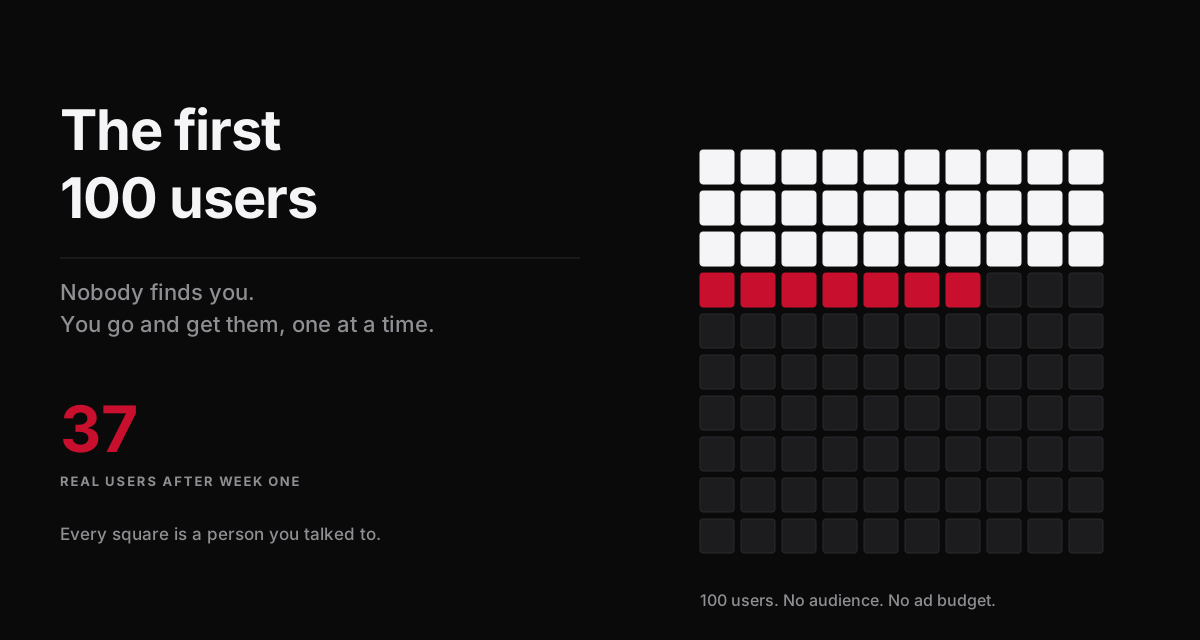
You built the thing. You posted it once. Four people liked the post, two of them are your friends, and nobody signed up.
This is the point where most founders quietly decide the problem is marketing, and start reading about marketing instead of getting users. It is not a marketing problem. It is an arithmetic problem, and the arithmetic is not on your side yet.
Your first 100 users are not attracted. They are recruited, one at a time, by you, by name. That work is boring, it does not scale, and it is the only thing that reliably works when you have no audience and no budget.
Why "get users" is the wrong instruction
"Get users" is not a task. It has no first step, no deadline, and no way to fail, which is exactly why founders can spend a month on it and produce nothing. Compare these two:
- Get users for the app.
- Send 20 personal messages to people who posted in r/freelance about chasing late invoices, by Thursday.
The first one you can do badly forever. The second one you either did or you did not. Distribution only becomes real when it turns into a countable action with a date on it, which is the same standard that separates fake work from real progress.
So before anything else, write down the number. Not "some users". One hundred, by a date roughly four weeks out.
The math nobody shows you
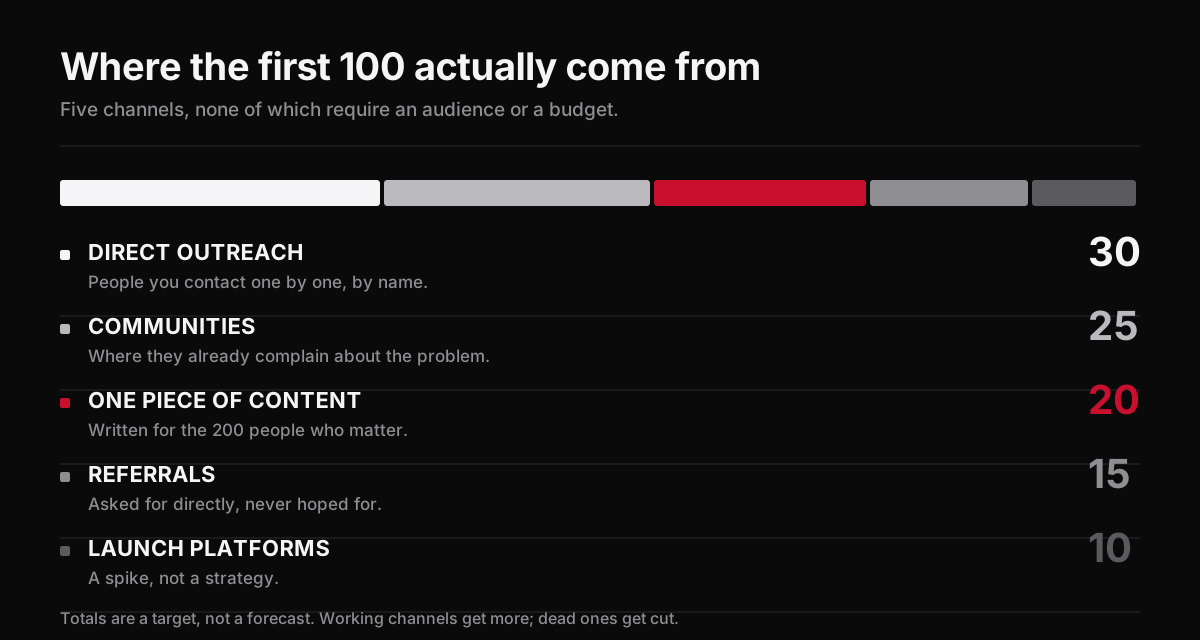
Founders imagine 100 users arriving as a wave. They arrive as a grind, at rates that look insulting until you actually run them.
| Channel | Reach out to | Realistic reply rate | Users |
|---|---|---|---|
| Direct outreach | 300 people | ~10% convert | 30 |
| Communities | 8 to 10 threads | varies wildly | 25 |
| One good piece of content | 1 post, 1,000 readers | ~2% | 20 |
| Referrals | 40 asks | ~35% | 15 |
| Launch platforms | 1 launch | one-off spike | 10 |
Look at the first row. Three hundred individual messages to get thirty users. That is roughly 15 messages a day for a month, and it is the single highest-yield thing an unknown founder can do. Everyone knows this. Almost nobody does it, because it feels beneath them and because rejection at that volume is genuinely unpleasant.
Paul Graham's Do Things That Don't Scale is the canonical argument for exactly this: the early work that matters is manual, unglamorous, and done by hand. Airbnb's founders went door to door. Stripe signed up early users by installing it for them on the spot.
The numbers above are a starting hypothesis, not a promise. Run them for a week, replace them with your real rates, then double down on whatever channel actually converted and kill the rest.
Channel 1: Direct outreach (30 users)
This is where most of your first 100 come from. The method is simple and the discipline is the hard part.
Find people with the problem, in public. Not "my target demographic". Actual named humans who have written, in the last 90 days, about the specific pain you fix. Reddit threads, X replies, LinkedIn comments, Discord messages, Facebook group posts, GitHub issues, App Store reviews of your competitor. Every one of those is a person who has already raised their hand.
Build a list of 300. A spreadsheet: name, where you found them, the exact sentence they wrote about the problem, link, date contacted, reply. If you cannot find 300 people publicly complaining about the problem, that is not an outreach failure. That is a signal you should have caught during validation, and you need to go back and check whether the pain is real.
Write messages that could only have been sent to that person. The whole thing rests on one line proving you read what they wrote:
Saw your comment about spending Sunday nights rebuilding the same invoice in Google Docs. I built a thing that does that in about 30 seconds. Want me to set it up on your stuff so you can see if it actually helps? Takes me five minutes, costs you nothing.
No pitch, no feature list, no link dump. An offer to do the work for them. If you cannot personalise it, do not send it. Mass-blasted DMs get you ignored at best and banned at worst, and they burn the channel permanently.
Offer to onboard them personally. Get on a call. Set the thing up while they watch. This is the highest-value hour in early-stage building, because you get a user and a live usability test at the same time, and you hear the exact words they use for the problem. Those words become your landing page copy. If you are not sure what to ask while you have them, the customer interview questions work just as well post-signup.
Channel 2: Communities (25 users)
Communities are where 100 people with your exact problem have already gathered themselves. They are also where founders get banned in week one for treating it like a billboard.
Pick three. Not fifteen. Three places where your users genuinely hang out, and where the moderators have not banned self-promotion outright. Read the rules first, literally, including the sidebar and the pinned posts.
Then spend two weeks being useful before you mention what you built. Answer questions with real answers. Post something people can use without signing up for anything. When somebody describes the exact problem you solve, that is when you say "I built something for this, happy to send it over" in a reply, not in a post.
The founders who get real users from communities are the ones who were already members. The ones who get nothing are the ones who show up on day one with a launch announcement.
Where to look: subreddits for the profession rather than for startups, niche Discord and Slack groups, Facebook groups for local trades and hobbies, Indie Hackers, Hacker News "Ask HN" threads, professional forums that look like they were built in 2008. That last category is consistently underrated and almost never competitive.
Channel 3: One piece of content (20 users)
Not a content strategy. Not a blog. One thing, written for the exact people you want, published where they already are.
The rule is that it has to be useful to somebody who never buys from you. The template, the teardown, the number nobody publishes, the thing you learned building it. Founders waste months on "content" that is a product pitch in disguise, and it converts at zero because everybody can smell it.
Publish it where the readers already are, which usually means the community you have spent two weeks in, not your own site where nobody will find it for six months. SEO is a real channel and a slow one. It pays off in month nine, not week two, so it is not how you get your first 100.
Channel 4: Referrals (15 users)
Every user you already have knows other people with the same problem. Almost none of them will refer you spontaneously, because it never occurs to them.
So ask. Directly, once, at the right moment, which is right after somebody tells you the thing worked:
Glad it helped. Who else do you know dealing with this? Happy to set it up for them the same way I did for you.
Ask by name if you can see their network. "Do you know anyone" gets you a vague yes and nothing else. "Would you introduce me to the two other freelancers in your Slack group" gets you two intros. Specificity is the entire game here, the same way it is in everything else that actually moves a startup.
Channel 5: Launch platforms (10 users)
Product Hunt, Hacker News Show HN, Betalist, Reddit launch threads, Indie Hackers. Worth doing once. Not worth the three weeks founders spend preparing for it.
The honest expectation: a spike of traffic, a handful of signups, most of whom never come back, and a small number of genuinely useful comments. Treat it as a one-day event that produces feedback and a few users, not as your distribution plan. Founders who build their entire launch around a Product Hunt day and get 40 upvotes are devastated, and they are devastated because they mistook an event for a strategy.
The four-week version
| Week | The only thing that matters | Countable output |
|---|---|---|
| 1 | Build the list, join the communities | 300 named prospects, 3 communities joined, 50 messages sent |
| 2 | Outreach volume plus being useful in public | 100 more messages, 10 real replies, 5 onboarding calls |
| 3 | Publish the one piece of content, keep messaging | 1 post live, 150 more messages, first 30 users |
| 4 | Launch, ask every user for a referral | Launch posted, 40 referral asks, 100 users |
Every row has a number, so every week either happened or it did not. That is the point. A week you cannot grade is a week you can lie to yourself about, and that is how side projects die: not in a dramatic failure, but in a month of vague activity nobody ever scored.
What does not work when you have no audience and no budget
- Paid ads. With no audience, no budget, and no proven conversion rate, you are paying to learn something outreach teaches you for free.
- Building in public, to nobody. Posting your MRR chart to 40 followers is not distribution. Building in public works once you have an audience. It is not how you get one.
- Another landing page redesign. If 300 people have not seen the current one, the design is not the constraint.
- Waiting until it is ready. The version you are embarrassed by gets you users and information. The perfect version gets you neither, later. If you genuinely cannot tell whether it is ready, here is the test.
- Automated DM tools. They get you banned from the exact communities where your users live, and you only get to be banned once.
How to know it is working
Signups are the vanity number. Track these instead:
- Reply rate on outreach. Under 5% means your message is generic or your list is wrong. Fix the message first, it is faster.
- Activation. How many signups actually did the core thing once. If this is under 30%, more users will not save you, and you have an onboarding problem rather than a distribution problem.
- Week-two retention. How many came back. This is the only early number that predicts anything.
- Unprompted referrals. Rare, and the strongest signal you will get in the first 100 that you built something real. It is what actually counts as validation.
Ten users who use it weekly beat 100 who signed up and vanished. If retention is zero, stop recruiting and go find out why, because pouring more people into a leaking product just costs you the audience you would have had.
The bottom line
There is no growth hack for the first 100 users. There is a list of names, a message you wrote yourself, and the discipline to send it 300 times while nothing appears to be happening.
The founders who get there are not better marketers. They are the ones who turned "get users" into 15 messages a day with a deadline attached, and then actually sent them on the days they did not feel like it.
If you want that turned into dated tasks and graded by something that will not accept "I posted about it" as an answer, that is exactly what GRILLR does. It builds the plan, sets the deadlines, and refuses to mark the week done without proof.
Key takeaways
- Your first 100 users are recruited one at a time by name, not attracted by marketing.
- Direct outreach is the highest-yield channel: roughly 300 personal messages for 30 users.
- "Get users" is not a task. Turn it into a countable action with a number and a deadline.
- If you cannot find 300 people publicly complaining about the problem, that is a validation failure, not an outreach failure.
- Track reply rate, activation, and week-two retention. Signups on their own are a vanity number.
- Paid ads, building in public to nobody, and another landing page redesign are all avoidance at this stage.
Done reading? Stop planning and start building.
Start building