PRD Examples: A Practical 2026 Guide for Founders
Real PRD examples and templates for founders: what a product requirements document must contain, mistakes to avoid, and how to write one that ships.
prd examples
What is a product requirements document and why does it matter?
A product requirements document (PRD) is the single artifact that defines what you're building, who it serves, and how you'll know it worked. It is not a technical spec. It does not tell engineers how to write code. It tells your entire team what problem you're solving and what a successful outcome looks like, before anyone writes a line of code or designs a screen.
Every effective PRD covers the same core ground:
- Objectives: The product goal and why it matters to the business
- Problem statement: The specific user or market problem, grounded in evidence
- User stories: Written as "As a [user], I want to [do X], so that [I achieve Y]"
- Success metrics: Measurable outcomes, not vague aspirations
- Scope and non-goals: What you're building and, critically, what you're not
- Assumptions and open questions: What you believe to be true and what still needs an answer
Without this document, teams build what they assume is needed. That is expensive.
PRD examples: standard template structures that actually work
Standard PRD templates in 2026 share a consistent skeleton, even when the format varies by team. The sections below appear across nearly every effective sample PRD:

| Section | What it contains |
|---|---|
| Status and author | Draft, In Review, or Approved; who owns the document |
| Problem statement | The user or business problem, backed by research or data |
| User stories | Feature requirements written from the user's perspective |
| Functional requirements | What the product must do, without dictating how |
| Success metrics | KPIs such as improving conversion within a few weeks or reducing churn |
| Non-goals | Explicit list of what is out of scope |
| Open questions | Unresolved decisions flagged for the team |
| Release planning | Target sprint or quarter, reviewers, tracking ticket |
A worked example from a real PRD template for an SSO checkout feature shows this in practice: the author lists the problem ("guests abandon at login"), writes two user stories, defines acceptance criteria, and flags one open question for the data team. That is the whole document. Short, clear, and enough to ship.
Best practices and misconceptions when writing PRDs
The biggest mistake founders make is treating a PRD as a static technical specification. PRDs work best as evidence-based narratives focused on the problem and the desired outcome, not on implementation details. Over-prescribing the "how" kills engineering creativity and slows the team down.
Common pitfalls to avoid:
- Writing feature descriptions before articulating the problem
- Using vague requirements like "the feature should be fast" instead of "page loads in under two seconds on a 4G connection"
- Skipping non-goals, which invites scope creep
- Treating the PRD as finished once it is written
Best practices that separate good PRDs from great ones:
- Keep it concise and compelling; long documents lose the team
- Include an Open Questions section to prevent mid-sprint blockers
- Involve engineers and designers in the draft early to catch constraints you would miss alone
- Update the document when requirements change, even briefly
Pro Tip: Write your non-goals section before your functional requirements. Knowing what you will not build forces clarity on what you will.
How early-stage founders can use PRDs to ship faster
For early-stage founders, a PRD is not bureaucracy. It is a forcing function. Defining scope explicitly prevents the feature creep that kills most side projects before launch. A one-page PRD written before your first sprint saves weeks of rework.
Practical tips for founders:
- Write a problem statement before touching any solution
- Set one or two success metrics you can measure in a short timeframe
- List at least three non-goals to protect your MVP scope
- Flag open questions rather than guessing; assign each an owner and a due date
Consider a fictional but realistic example: a startup building adaptive learning paths for workforce training. Their PRD connects to a clear product objective ("improve learner retention"), defines two user stories for learners and managers, and sets a measurable key result. The open questions section flags which three metrics predict retention, assigned to the data team with a deadline. That structure keeps the sprint moving without constant check-ins.
Pro Tip: Treat your PRD as a living document. Update it after every user interview or technical discovery session. A PRD that reflects what you actually learned is worth ten times more than one that reflects what you assumed.
Grillr is built for exactly this discipline. As an AI accountability partner for early-stage founders, Grillr stress-tests your idea, grades your submitted tasks PASS or FAIL, and generates PRDs alongside your business plan so nothing slips through.
Real-world PRD examples across industries
PRDs look different depending on the product type, but the structure holds.
- SaaS feature (checkout SSO): Short PRD with a clear problem statement, two user stories, acceptance criteria, and one open question for the data team. Fits on a single page.
- Consumer app (music discovery): Spotify-style PRDs connect user behavior data to feature scope, with success metrics tied to session length and playlist saves.
- Enterprise software (LMS adaptive learning): Longer PRDs with persona sections, customer feedback summaries, and phased release planning tied to OKRs.
- Infrastructure tooling (CLI sync tool): Technical PRDs that describe the desired behavior of a command-line tool without specifying implementation, leaving architecture decisions to engineering.
- Dashboard redesign: A PRD that opens with a TL;DR ("14 metrics with no hierarchy; new users drop off") and sets a concrete goal: reduce step churn and increase users who get value in their first session.
The format shifts. The discipline does not.
Why effective PRDs work: an analysis
The best PRDs connect strategy, user evidence, and measurable success into a story the whole team can act on. Three qualities separate them from weak documents.
First, they start with the problem, not the solution. A PRD that opens with a feature description has already failed. The problem statement anchors every decision that follows.
Second, they make decisions visible. Good PRDs facilitate conversation between product, design, and engineering rather than documenting exhaustive specs. When a decision is unresolved, it appears in the Open Questions section with an owner, not buried in a Slack thread.
Third, they define success concretely. "Users should find it intuitive" is not a success metric. "Users complete the core action without consulting help documentation" is.
Common mistakes illustrated through flawed PRD examples
A flawed PRD is easy to spot once you know what to look for.
- The feature dump: A document that lists 20 features with no problem statement. No one knows why any of it matters.
- The implementation spec: A PRD that tells engineers which database schema to use. Engineering stops thinking; you get exactly what you asked for, not what you needed.
- The vague metric: Success defined as "increase engagement." No baseline, no target, no timeframe. Unmeasurable.
- The frozen artifact: A PRD written in week one and never touched again, even after three user interviews changed the direction entirely.
- The missing non-goals section: Every stakeholder adds one more "small" feature. The MVP ships six months late.
Each of these mistakes has the same root cause: the PRD was written to document a decision already made, not to align a team around a problem still being solved.
Tools that help you create PRDs with real examples
Several tools support PRD creation with built-in templates and collaboration features.
- Confluence integrates tightly with Jira, making it straightforward to link PRD user stories directly to engineering tickets for traceability.
- Notion offers flexible, database-driven PRDs that connect to roadmaps and research docs in the same workspace.
- Miro suits visual teams; its PRD boards combine narrative sections with wireframes and user flow diagrams on one canvas.
- Airtable provides structured templates with workflow options, useful when your PRD needs to connect to sprint planning or launch checklists.
For founders who need a PRD generated as part of a broader business plan, Grillr produces PRDs alongside market research and pitch decks, grounded in validated assumptions rather than guesswork.
How to tailor PRD examples for different roles and stakeholders
A PRD written for one audience will not work for all of them. Tailor the depth and emphasis based on who reads it.
- Engineers need precise functional requirements and clear acceptance criteria. Vague language costs them hours of back-and-forth.
- Designers need user stories, personas, and problem context. They do not need implementation constraints that box in their solutions.
- Executives need the problem statement, success metrics, and strategic fit. One paragraph each. Skip the user story format entirely.
- Go-to-market teams need release scope, non-goals, and the target user. They are planning positioning, not building features.
The core document stays the same. What changes is which sections you emphasize in your kickoff meeting or stakeholder review. A PRD that tries to serve every reader equally often serves none of them well.
Start shipping with a PRD that actually works
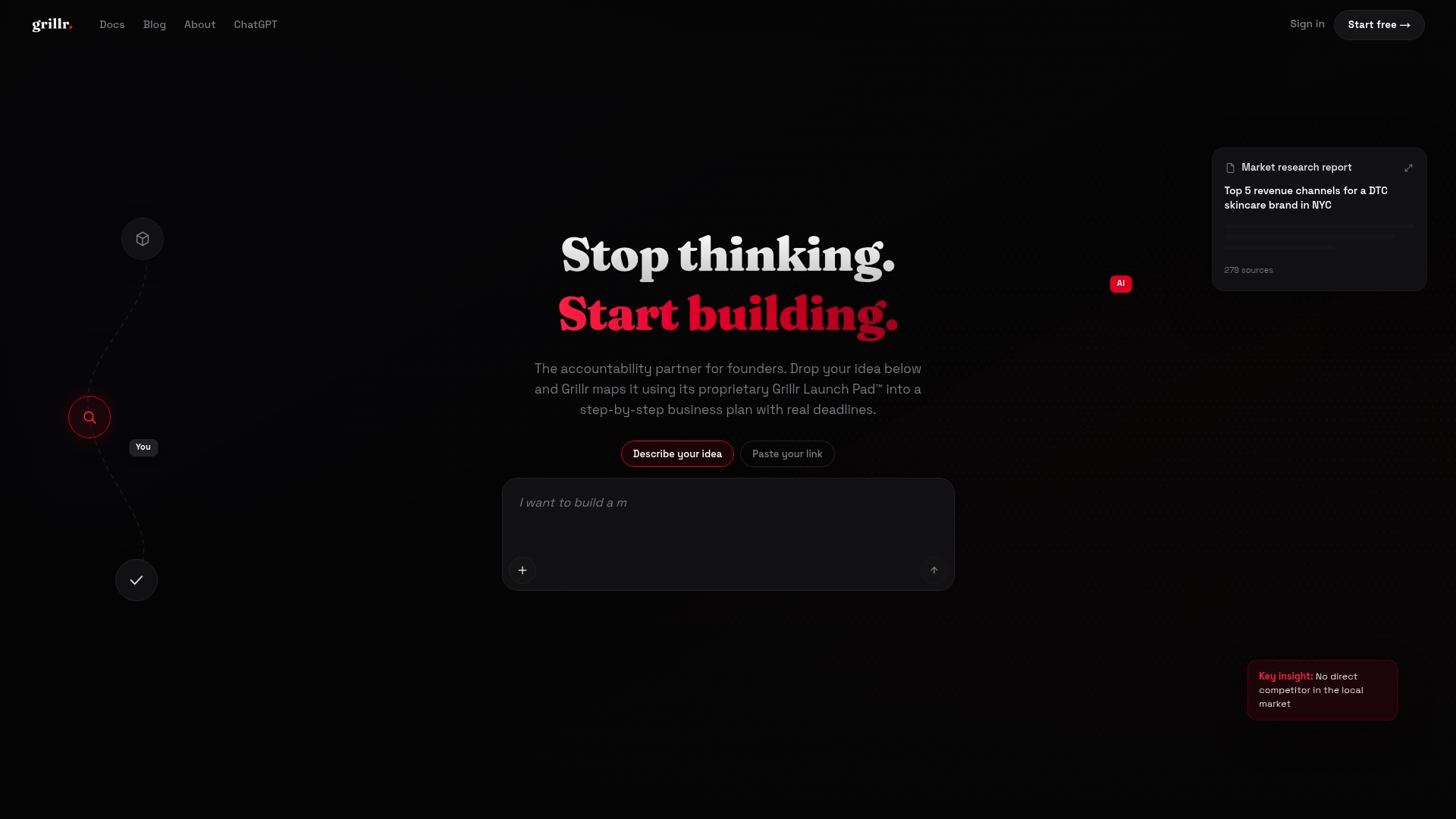
A PRD is only as good as the discipline behind it. Grillr gives early-stage founders the structure to validate their idea before writing a single requirement, then generates a PRD grounded in real market research and user evidence. No guessing. No wasted sprints. Just a clear plan with deadlines, graded tasks, and honest feedback at every step.
Key takeaways
- Start with the problem: write your problem statement before any feature description to anchor every decision.
- Treat the PRD as a living document: update it after every user interview or discovery session.
- Define non-goals explicitly: listing what you will not build protects MVP scope and prevents feature creep.
- Make success measurable: replace vague goals with concrete metrics tied to a timeframe and a baseline.
- Tailor depth by audience: engineers need precise criteria, executives need strategy, designers need user context.
Done reading? Stop planning and start building.
Start building