
When to Kill Your Startup Idea (and When You Are Just Tired)
How to tell a dead startup idea from a tired founder: five counted kill signals, the false alarms that fool people, and how to write kill criteria before you need them.
when to kill your startup idea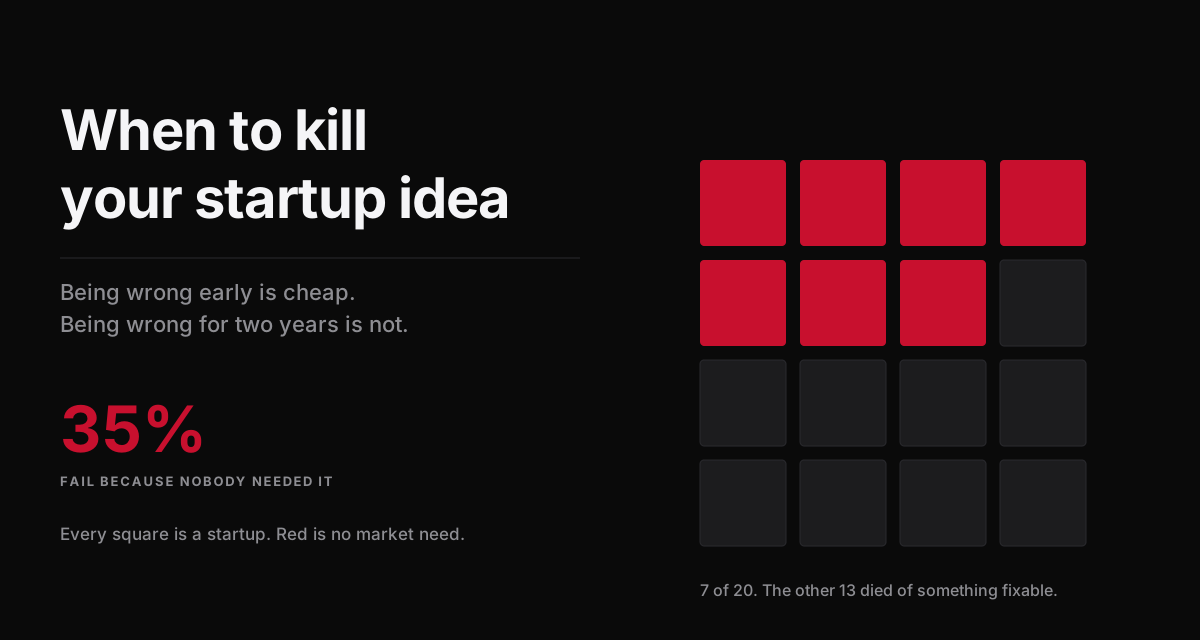
Eight months in, a few dozen signups, nobody paying, and you genuinely cannot tell whether you are three weeks from traction or two years into a mistake. Knowing when to kill your startup idea is the least discussed skill in building anything, because everyone who writes about persistence is a survivor, and survivors give terrible advice about quitting.
Here is the part nobody puts on a poster: most ideas should be killed. Not because founders are lazy, but because most ideas are wrong, and being wrong in month three costs you a weekend while being wrong in year two costs you the years. The founders who ship five things in the time you ship one are not faster builders. They are faster killers.
The trouble is that the question almost never gets asked at a moment when you can answer it honestly. It gets asked at 11pm on a Sunday, after a bad week, with no data on the table and your entire self-image in the room. So this is not an argument for quitting or against it. It is a test you can run on a Tuesday morning with numbers in front of you.
A dead idea and a tired founder feel identical from the inside
They are not the same thing, and they have opposite fixes. Killing a good idea because you are exhausted is as expensive as nursing a dead one because you are stubborn.
| Dead idea | Tired founder | |
|---|---|---|
| What is missing | Demand | Energy |
| The evidence | People tried it and did not come back | You have not shipped in three weeks |
| How it feels | Bored explaining it to people | Guilty about not working on it |
| What new users do | Sign up, poke it once, vanish | There have been no new users to observe |
| The fix | Kill it | Sleep, then ship one small thing |
If you have not shipped anything in a month, you do not have data about your idea. You have data about your calendar. Rest, ship one small visible thing, then come back to this question with a real week behind you.
There is a tiebreaker for the genuinely ambiguous case. Imagine a stranger launches your exact idea tomorrow and gets 500 paying customers. If your gut reaction is irritation, that you should have moved faster, the idea is alive and you are tired. If your gut reaction is quiet relief, you already made the decision and you are looking for permission.
That test is not rigorous. It is for tiebreaks. The signals below are the real thing.
When to kill your startup idea: five signals that actually count
Each of these has a number attached, on purpose. A signal you cannot count is a mood.
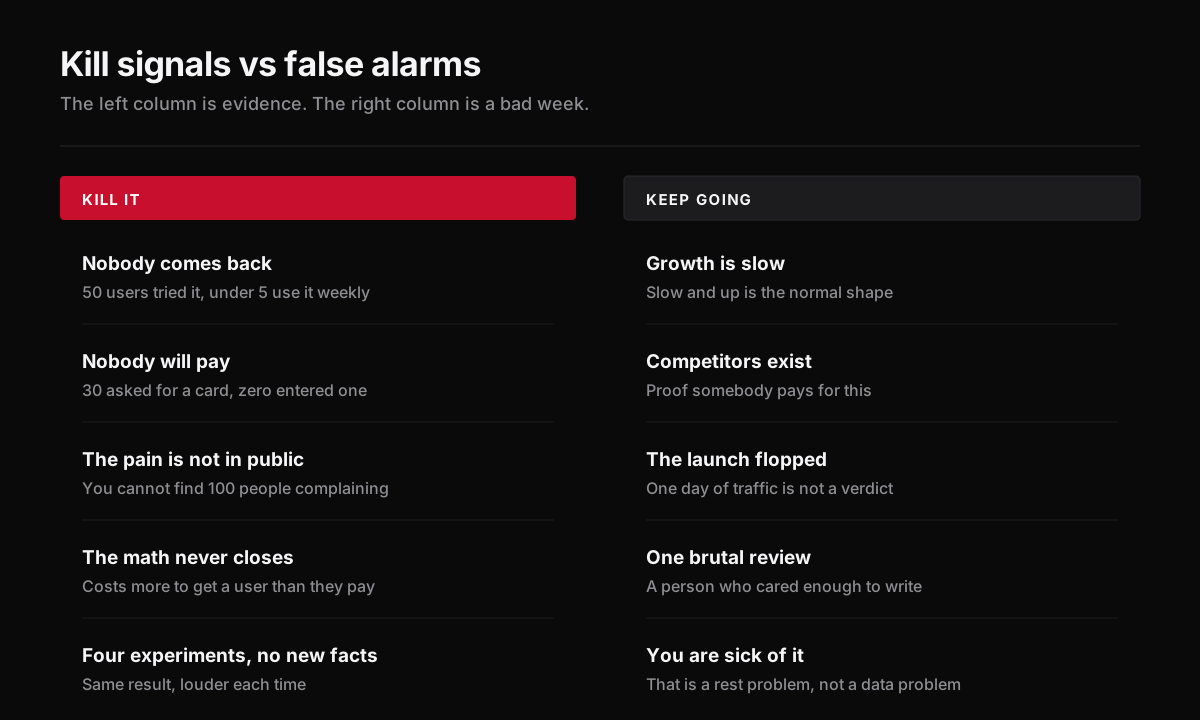
1. Nobody comes back. Fifty people have used it and fewer than five use it in a normal week. Retention is the only early number that predicts anything, and it is the one founders quietly stop looking at. More signups will not save a product nobody returns to. They just cost you the audience you would have had later. This is what counts as real validation and what does not.
2. Nobody will pay, including the enthusiasts. You put a real payment form in front of thirty people who told you they loved it and zero entered a card. Not "they said the price was high". Zero. Verbal enthusiasm is free and people hand it out to be nice. A card is the cheapest honest signal you can buy, which is why avoiding the ask is the most common form of fake work in the whole game.
3. The pain does not exist in public. You cannot find 100 people who have complained about this problem online in the last 90 days. Not "my target market is hard to reach". You genuinely cannot find them, in any subreddit, forum, review section, or Discord. If the pain were real and unsolved, somebody would have written about it angrily. This is the check that belongs in validation, before you build, and it is the one people skip.
4. The math never closes. It costs more to acquire a customer than they will ever pay you, and no version of the funnel fixes that gap. You do not need a spreadsheet with 40 rows. You need two numbers: what one customer is worth over their life, and what it costs to get one. If the second is bigger and the only fix is a growth channel you have never actually run, that is not a plan, it is a wish.
5. Four experiments, no new information. You have redesigned the landing page, changed the pricing, switched the target audience, and rewritten the copy. The result was the same each time. At that point you are not testing anything. You are decorating a hypothesis that has already answered you. CB Insights has run this teardown across hundreds of failed startups and no market need sits at the top of the list, ahead of running out of cash, because most cash gets spent finding out.
One of these is a warning. Two is a conversation. Three or more, for more than a month, and you are not deciding whether to kill it. You are deciding how long to keep paying for a decision you already made.
The signals that look fatal and are not
Half of all quitting happens on evidence that means nothing. Do not kill an idea for any of these on their own.
- Growth is slow. Slow and upward is the normal shape of a real business. Flat is the problem, not slow.
- Competitors exist. Competitors are proof that somebody pays money for this. A market with no competitors is usually a market with no customers, which is a much worse position to be in.
- The launch flopped. One day of traffic on a launch platform is an event, not a verdict. Plenty of good products get 40 upvotes. That is why launch day is the smallest channel in getting your first 100 users.
- Somebody wrote you a brutal review. A person who took twenty minutes to explain why your thing is bad cares more than the 900 people who said nothing.
- You are sick of the sight of it. That is a rest problem wearing a strategy costume. Every long project has a stretch that feels like this, and it is where most side projects actually die, not at a moment of clear failure.
Write the kill criteria before you need them
The decision is agonising because you make it at the worst possible moment: fully invested, out of energy, with months of sunk cost sitting behind you. Sunk cost is the trap here. The eight months are gone whether you continue or not, so they are not an input. The only question is whether the next three months are a good use of your life, judged from today.
The fix is to decide in advance, while you are calm and the cost is still zero. A kill criterion has three parts: a number, a date, and an action.
By 15 September I will have 40 people who used the export at least twice, and 5 who paid. If I do not, I stop building features and either take the tool to a different audience or shut it down.
Write that at the start of every phase, not at the end. If you find yourself unable to write a number down, that is its own answer: you do not know what success looks like, so you would not recognise failure either. A validation checklist is useful for exactly this reason, because it turns a vibe into pass or fail.
Run one last experiment before you pull the plug
Before you kill anything, run the single highest-signal test you have been avoiding. You know which one it is. It is almost always asking for money, or talking to ten users in a row about why they stopped.
Give it 30 days, one hypothesis, and a written threshold. Not a redesign, not a new feature, not a rebrand. One test that can come back negative. If it comes back negative, you kill it with a clear conscience instead of wondering for the next two years.
What you actually keep when you kill it
Killing an idea is not deleting eight months. You walk away holding:
- The list of people. Everyone you talked to about the problem. That list is the single most reusable asset you have and it transfers to your next idea intact.
- The knowledge. You now know a market better than 99% of people who will enter it. That is why second attempts move faster.
- The code. Auth, billing, deploy pipeline, the boring 40% of any product.
- The proof that you finish things. Shutting something down deliberately, with a written reason, is a stronger signal to investors and future partners than quietly letting it rot.
Then do the closing properly. Write a one page postmortem: what you believed, what happened, what you would test first next time. Tell the people who used it, and tell whoever you have been reporting progress to. Archive the repo, do not delete it. Take two weeks off before starting the next thing, because starting a new idea while running from the last one is how you pick a bad one.
The bottom line
Most founders do not need help persisting. They need help telling the difference between a hard week and a dead market. Knowing when to kill your startup idea comes down to whether you can name three counted signals that have not moved in a month, and whether you wrote your kill criteria down while you still had the objectivity to write them.
If nobody comes back, nobody pays, and nobody complains about the problem in public, that is not a motivation problem and no amount of grinding will fix it. Kill it, keep the list, and go find a problem people are already angry about.
If you want somebody to hold the number you set in June and refuse to renegotiate it in September, that is the entire point of GRILLR. It writes the criteria with you, dates them, and does not accept "it is starting to pick up" as evidence. Deciding when to kill your startup idea gets a lot easier when the standard was set months before the answer mattered, by something that will not let you quietly move it.
Key takeaways
- Most ideas should be killed. Being wrong in month three costs a weekend, being wrong in year two costs the years.
- A dead idea and a tired founder feel identical inside and have opposite fixes. No shipping for a month means you have data about your calendar, not your idea.
- Five counted kill signals: nobody returns, nobody pays, the pain is not in public, the math never closes, four experiments produced no new facts.
- Slow growth, competitors, a flopped launch, and one brutal review are false alarms. Do not quit on any of them alone.
- Write kill criteria in advance: a number, a date, and an action. If you cannot write the number, you would not recognise failure either.
- Sunk cost is not an input. The only question is whether the next three months are a good use of your life, judged from today.
Done reading? Stop planning and start building.
Start building